

Pure Tantalum vs. Ta-2.5W vs. Ta-10W: Material Selection Guide
Which Material Does Your Application Need?
When designing equipment for aggressive chemical processes or high-temperature vacuum furnaces, tantalum (Ta) is usually the first metal engineers consider. Its natural oxide layer provides near-total corrosion resistance against mineral acids such as hydrochloric acid (HCl), sulfuric acid (H2SO4), and nitric acid (HNO3), while its melting point of 3,017°C (5,463°F) easily handles extreme heat.
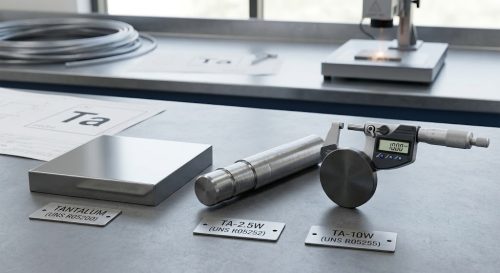
However, unalloyed pure tantalum has one major limitation: it is relatively soft and ductile.
In applications involving elevated pressures, fast-flowing corrosive media, or structural loads, pure tantalum components can deform, erode, or require thick, costly wall profiles.
To solve this challenge, metallurgists alloy tantalum with tungsten (W) to create Ta-2.5W and Ta-10W. Adding tungsten significantly increases yield strength and hardness while maintaining tantalum’s exceptional corrosion resistance.
Here is a practical guide comparing these three options to help you select the ideal grade for your project.
Quick Comparison: Pure Ta vs. Ta-2.5W vs. Ta-10W
| Grade / Alloy | UNS Number | Typical Specifications | Yield Strength | Tensile Strength (UTS) | Best Applications |
|---|---|---|---|---|---|
| Pure Tantalum | UNS R05200 / R05400 | ASTM B708, B365, B521 | 20 – 35 ksi (140 – 240 MPa) | 30 – 45 ksi (205 – 310 MPa) | Clad vessel linings, deep-drawn parts, low-pressure rupture discs |
| Ta-2.5% Tungsten | UNS R05252 | ASTM B708, B365, B521, AMS 7848 | 40 – 55 ksi (280 – 380 MPa) | 55 – 70 ksi (380 – 480 MPa) | Heat exchanger tubes, threaded fasteners, reactor internals |
| Ta-10% Tungsten | UNS R05255 | ASTM B708, B365, B521, AMS 7847 | 70 – 90 ksi (480 – 620 MPa) | 90 – 115 ksi (620 – 790 MPa) | High-pressure valve stems, furnace heating elements, aerospace |
How Tungsten Changes Tantalum’s Properties
1. Mechanical Strength & Pressure Rating
Adding just 2.5% tungsten nearly doubles the yield strength of unalloyed tantalum. Increasing the tungsten content to 10% triples it.
For heat exchangers and process piping, this strength advantage is critical: it allows engineers to specify thinner tube and vessel walls. Thinner walls reduce total material weight, lower material costs, and significantly improve heat transfer efficiency.
2. Corrosion Resistance
Alloying with tungsten does not sacrifice chemical inertness. Both Ta-2.5W and Ta-10W remain virtually immune to wet chlorine, hydrochloric acid, nitric acid, and sulfuric acid (at temperatures below 175°C / 347°F).
(Note: As with all tantalum products, avoid exposure to hydrofluoric acid (HF), strong hot alkalis, and fuming sulfur trioxide.)
3. Machinability & Fabrication
- Pure Tantalum is exceptionally ductile and easy to cold-form, spin, or deep draw. However, it can be “gummy” during machining, requiring high positive-rake tooling and proper lubricants to prevent galling.
- Ta-2.5W offers the ideal middle ground. It produces cleaner chips than pure tantalum, resists galling, and retains plenty of ductility for bending, flanging, and rolling seamless tubes.
- Ta-10W machines cleanly with good chip control but is significantly harder (>220 HV). It work-hardens quickly, requiring rigid tooling setups, slower cutting speeds, and heavier forming equipment.
How to Choose the Right Grade
- Select Pure Tantalum (R05200 / R05400) if your component requires maximum cold formability, deep-drawn cups, protective vessel cladding, or ASTM F560 medical-grade material.
- Select Ta-2.5W (R05252) for shell-and-tube heat exchangers, bayonet heaters, high-strength threaded fasteners, mixer shafts, or piping handling turbulent fluid flow.
- Select Ta-10W (R05255) for severe high-pressure valves, high-wear spray nozzles, aerospace propulsion components, or vacuum furnace heating elements that must resist high-temperature sagging and creep.
Need Refractory Metal Expertise for Your Next Build?
For over 25 years, Admat Inc. has supplied certified, conflict-free refractory metals—including tantalum, niobium, tungsten, and molybdenum—in sheet, plate, wire, rod, tube, and custom machined parts.
All materials ship with complete mechanical and chemical Mill Test Reports to satisfy your quality and compliance requirements.
- Explore our tantalum products: admatinc.com/products/tantalum
- Contact our team: Call us at (484) 322-2091 or request a quote online to discuss your application specs.